Monday, August 5, 2024

The Mission of Oskar Hammar - Ch. 1, Part Six

 : From an unpublished book on the family’s history, written by Hetty Louise Dufour DuPlessis (1867-1933). Courtesy of the DuPlessis Family libraries.


“The DuPlessis mansion is an oddity, in every way, much like our family. An unusual mixture of Gothic and Georgian architecture originally designed by my Great Uncle Hiram DuPlessis, and  constructed over a ten year period from 1877 to 1887. I was fortunate to see it happen almost from the beginning, and I urge you to believe that it is an engrossing story!

The parcel of land, then on the outskirts of Jefferson City was bought by our ancestors, Jean-Phillipe and his brother Reynaud DuPlessis in 1854. Long before Uptown, as it came to be known, was developed. Family legend states that the brothers were both hiking through the area before dawn, when they were struck by the first light of sunrise. They had a vision of a grand mansion on that spot, and rushed back into town to lay claim to the land. Soon, they both took wives and built a small home here, guided by the sunrise hitting this spot every morning.

We are the descendants of Jean-Phillipe and Eleanora. Reynaud and his wife Filena left New Orleans suddenly before the Civil War, and never returned. It is believed by the neighbors and a few dissidents in the extended family that Reynaud, as the younger brother, was afraid of being conscripted to fight for the South and fled, too embarrassed to return. But, our beloved Great Uncle Hiram has always said that Reynaud left the States on a family mission, and someday his children will return. One can only wonder!

“Our home is known for the unique herringbone brickwork across the facade, an innovation by my late father, Julius DuPlessis. It is also known as ‘the big house on the little hill’, the land having been built up to avoid some long-forgotten flood or some other natural disaster, as I recall. In truth, I was only a child when the story was told, and all who would know have long since passed on. Though, it has been noted that, despite every hurricane and flood, the neighborhood has never taken water. Intriguing!

“It is also the only house where the front door faces due east. Every other house in Audubon Place faces each other across the streets, either northwest or southeast-the nightmares of the compass! Through some happy accident, even through the unchecked growth of the live oaks and development, the first light of morning shines directly onto the front door of the house, illuminating everything around it with golden sparkling light for several minutes before fading away. Always has, and did when the properties around us were being bought up and built upon.

“Naturally, the new folks were jealous.

“By 1920, a generation of new wealth upstarts, war profiteers, erstwhile carpetbaggers and lawyers had built up their own mansions, calling it Audubon Place and fencing out the rest of the City. Like feudal lords, admission to the street must be approved by a guard in a ridiculous little shack. They filled the newly paved street with a well-ordered opulence. Each one facing another in neat, regimented fashion. As if in constant watch for any deviation or new ostentation. Our oddly shaped lot and even odder mansion atop it was an affront to the well-ordered  lives they had constructed around themselves. An insult, really. How often were Mother and I drubbed by these people? They, either refusing to acknowledge our presence, or worse confronting us directly on the street like fishwives, braying their dismay at our beautiful home-the first home in the neighborhood, I am often wont to reply. A home that became the subject of discord at their supper tables. And they were not happy at all. Especially since our family didn’t care one way or another what any of them thought. We were here first. They were drawn to us, not the other way around.

“In 1923, to appease these dreadful people who threatened to have our mansion condemned and demolished if something wasn’t done, Father and his brother Ivor created a kind of false facade built along the front of the property, consisting of a low brick wall (again, with the herringbone patterning. As with most things, Father would only be told so much,) and cast iron trellising now grown through with carefully trimmed wisteria and ligustrum. It is also trained to grow along a new high fence on the Freret St. side, surrounding the property. When fully grown, the facade will completely obscure the entire house from both streets.”


During the 20th century, the mansion became so well hidden that the children and grandchildren of the neighbors eventually forgot there was another mansion in Audubon Place. Which, it seems, is what they wanted. And, the DuPlessis family preferred it that way. Despite their repeated issues, the presence of wealthy neighbors in a closed community was a welcome buffer from the world. The natural transience of the universities supplied them with anonymity every few years. It allowed the family, over generations, to not only build the mansion’s grounds, but also the family fortunes. More than 70% of the entire City of New Orleans is either owned, co-owned, managed, or controlled by the DuPlessis family and all their many businesses and conglomerates. Even their own wealthy neighbors don’t know they bought their land from the family, and their business offices and locations pay rent to them as well. Most of the residents in the City pay rent to the family in some way. A veritable army of accountants and bankers work their entire careers on the DuPlessis’ fortunes, all very handsomely paid. And all controlled from this mansion at the tiny, perfectly manicured hands of Bitsie DuPlessis.

Bitsie herself is not a true DuPlessis. Rather, she is the ex-wife of the last of the DuPlessis line, Ivan. Or, she would be his ex-wife had Ivan not gone missing nearly six years ago before the divorce could go through. Still just over a year away from finally having Ivan declared legally dead, she is the sole agent and executor of the vast DuPlessis fortune and matron of the family manse.

Hetty continues.


“Another unusual feature of the mansion is the sunken first floor. Built down into the land that raises the mansion, to enter one must first climb up an ornate staircase to the front door. Inside, one is greeted by an entry hall that opens out into an open, circular space in the center of the mansion with three staircases branching out into the rest of the house: on the left, the staircase going down to the first floor living rooms and kitchens; on the right, a staircase leading up to the third floor rooms, and before one, a third, shorter cantilevered suspended staircase leading to the semi-detached second floor study. The study was built by Jean Pierre for himself. Family tradition says the head of the household is given the only key.

All three staircases are made from gilded iron lace with mahogany wood treads and banisters. Around the doors to the study, two large, thick windows framed with cast iron flood the area with light. From those windows, you can see the glass roof of a solarium on the first floor, also built into the center of the mansion.

This was done according to Great Uncle Hiram DuPlessis’ original plans. Though I have never seen them, the entire first floor of the mansion is said to be supported on large iron beams; presumably because the pavers are so heavy. It is always feared in New Orleans that we shall all sink into the swamps one day.

“Down the stairs to the left you go, through a paneled passageway that leads into the large living room and dining area. The living room is paneled in an unusual wood called guyican. Imported, it is believed, from the Caribbean sometime in late 1872. Its burnt umber color compliments the mahogany bookcases that line the room, as well as the curiously sleek white marble mantlepiece framing the large fireplace. It is the only item in the house that can be considered spartan. Only the wall with the fireplace has been left open. It is bare, save for the  enticing antique lead crystal and elegant gilded iron lace sconces on either side of the mantle, and a large gilded antique mirror that nearly fills the space. Equally curious is the luxurious, unusually thick slate floor. In the streaming light from the solarium the dark slate becomes a deep purple. Unique in the entire state, slate is said to have been mined and cut in Colombia. Each tile is so heavy, it took over two years for all of them to arrive and be installed. On the left side of the fireplace wall there is a small staircase to a private office, purportedly created and hidden by Uncle Reynaud during construction. On the right, opposite the entryway is a large grand dining room that looks out onto the solarium, paneled again in guyican, and featuring a mural on the ceiling depicting the arrival of the first DuPlessis on Louisiana soil in 1713, painted by a young artist named Alferez.”


Atop the tiles in the center of the room is a gold and white braided rug bearing the family crest of the DuPlessis family. The legacy of Bitsie’s blessedly dead mother in law, the imperious Alice DuPlessis. Luxurious brown leather couches border the rug on either side, fitted with thick lead glass coffee tables that stretch the length of the sofas. On one side closest to the entryway, a single overstuffed leather chair that doesn’t match anything else in the house. It is Bitsie’s big chair; the last vestige of her life before she became a DuPlessis. The big chair sits up against one of the two columns that separate the living room from the breakfast area, which looks out onto the solarium. Beyond the breakfast area are the kitchens and service rooms, the exclusive purview of Schramm. This part of the house is the only part that has been renovated, albeit minorly, to accommodate modern appliances. The laundry room opens out into the three-car garage, also below ground and guarded by a large bespoke electric door made of thick planks of live oak and iron fittings. In Hetty’s time, the garage was the carriage house and her father’s workshop. His workbenches still line the walls of the garage, and an imposing wooden chest of his special tools sits in the corner: the lock that seals it shut possessing no keyhole, the wood too thick to be drilled or chipped away…This is My New Orleans.

The Mission of Oskar Hammar - Ch. 1, Part Five

 : The tarmac at Louis Armstrong International Airport is busy. Planes maneuver themselves around the new facilities with ease, bringing visitors from around the world to the Crescent City. The concourses are bustling with humanity, rushing to catch connecting flights or strolling aimlessly as vacations begin and cohesive thought ends.

At least, that’s what Bitsie assumes.

Currently, she is standing alone by the limo behind the old airport, deserted except for some assorted men in a service shed by the landing strip. Planes haven’t landed on this runway in years, so of course Philomena Phistemopheles would be arriving here. No inconvenience too great.

Bitsie crushes out another cigarette and rinses the taste of cloves from her mouth with a shot of Japanese bourbon from her purse flask.

Bitsie had given up cigarettes for nearly thirty years before her first meeting with Philomena. She was riddled with crippling migraines whenever the woman was near. Then one day, Rony Parmentiere gave her one of his clove cigarettes and the migraines stopped. As long as she was smoking the cloves. The moment Philomena left town, the migraines and Bitsie stopped cold turkey. That turkey has been back in the smoker again for 24 hours. And it’s gonna stay there until Phil gets the hell out of town or Bitsie wills herself to die.

It’s a gorgeous day though, she thinks. Chilly, the sky, so clear and blue. Even the weeds coming up unchecked along the old tarmac are in bloom. And surprisingly quiet considering all the planes taking off less than half a mile away. She takes a deep breath and agrees with herself that it is a beautiful New Orleans spring day.

A dull bang snaps her out of it. The shed has opened and three men in jumpsuits rush out to the landing strip. Bitsie looks up to see a small, gaudy gold dot in the sky growing larger. The Phistemopheles private jet.

“Beautiful day” she says, lighting up another cigarette. She takes a long drag and exhales,

“And here you are, just in time to fuck it up.”

Reaching into her purse, she pulls out her Maybach Diplomat sunglasses and makes herself comfortable.

“Welcome back, Phil. No one missed you.”

Philomena’s gold Airbus 380 alights onto the runway like a gilded pelican, and swings around towards Bitsie. Two of the workers rush out to the luggage area while a third drives a stair-set up to the plane. She watches as an oval hole opens up on the side of the plane, only to be instantly darkened by the precisely tailored visage of Philomena Phistemopheles.

The overkill forces Bitsie to watch over the rims of her shades, just to be sure she’s she doesn't miss a beat of this performance.

Philomena is encased in a black structured dress that looks to Bitsie like Maleficent arriving at a board meeting. Over one shoulder, a sleek black mink bag.

"Probably skinned 'em with her teeth," she mutters.

Beneath a sheer black picture hat, the Phistemopheles tradmark blue-black mane is now accented by a blue-white shock in the center of her forehead, tortured into a nautilean curl. Even the burnish of her olive complexion pales against the bright blood-red lipstick, which is visible from a distance.

The exact distance being Biloxi.

Philomena spies Bitsie and descends the stairs towards her like a panther at Fashion Week. Seeing Philomena approach gives Bitsie a feeling like food poisoning without the pleasure of eating first. She quickly lights another clove cigarette, just to be on the safe side. Philomena takes her own sweet time as the airport workers scramble after her with more luggage than Samsonite makes in a year. Finally, the women stand face to face.

“Bitchy.”

“Baphomet.”

Philomena smiles unnervingly and trills in her thick Peloponnese accent,

“My darling. No one’s called me that in centuries.”

A deadpan sneer embedded on her face, Bitsie replies,

“Oh. Which name are you using now? Not Lucifer again. That’s so overdone.”

Philomena’s eyes narrow. Bitsie recognizes the warning sign, and takes a long drag off her cigarette.

“Not this time, Beelzebub,” she spits, a thick cloud of sweetly spiced smoke filling the air between them.

“I figured out how to stop your migraine trick the last time, so back off. I’m cloved-up and ready for you.” She takes another drag, blowing it into Phil’s face. Philomena merely smiles, unblinkingly acknowledging the victory. “Speaking of which, those God-awful blunts you like are in the back seat.” She walks back to the limo, complaining, “I had to drive here with all the windows down. Still smells like a funeral in Hell.”


She opens the back door and a stench like rotting horsemeat and burning electrical wires rushes out. Bitsie and the workers, about 15 feet away, all recoil. One of the men forcefully vomits onto the steps of the plane. Philomena smiles and walks towards the box on the seat. She picks it up, takes a long ardent sniff, and stuffs the box into her mink bag. Instantly, the stench is gone.

“Thank you Bitsie. That was kind of you” Philomena says politely.

Bitsie blinks uncomfortably and glances away at the workers struggling to move a Monkey Hill-sized mound of baggage and… old trunks? What, she couldn’t bring the good luggage?

“So, Phil. How did you get them to open Moisant just for you?”

Philomena smiles gracefully and says,

“The ambassador owed me a favor. Alexandra is such a lovely girl. She knows I despise crowds.”

The workers arrive with the baggage, looking worse for wear. It is taller than the limo.

“I’m not sure all of this will fit in the trunk, Phil,” Bitsie says. “If I’d have known, I’d have brought a U-Haul.”

“It will all fit. Just go sit up front. I will be there with you momentarily. Go.”

Not needing any reason to walk away from Philomena Phistemopheles, Bitsie turns and goes around the front of the limo, and climbs into the driver’s seat as packing begins. She can barely hear Phil and the crew outside.


She checks her phone. Message from Amanda; Phil's rooms are ready.

The limo begins rocking, and there is muffled shouting from the trunk.

Message from Rony; plane delayed, will call when they land.

The back doors of the limo open, and baggage is crammed in tighter than it should go. The privacy window behind her rises, cutting her off again. She pays no attention

Message from Stav; liquor arrived. Garage is full, will have to park in the driveway.

More shaking, and something screamed in Greek. Silence. The trunk and the doors all close.

No messages from Schramm. That’s concerning.

Before she knows it, Philomena is in the passenger seat next to her, the workers are nowhere to be seen, and the jet is turning to taxi back down the runway..

“That was quick” she says, starting the car. “I hope you tipped them well.”

“They were properly compensated, darling.” says Phil, producing one of her new cigars.


The pair drive back to the mansion in silence, save for the sound of rushing air from the open windows as they both smoke their choice of poison to pass the time. The clouds in their wake are visible all along the I-10, leading drivers behind them to believe a major accident has happened, causing a traffic jam. Coming up on the Causeway exit, Philomena suddenly barks,

“Darling! Take this exit. I want to drive by the Hammar home first.”

Bitsie looks askance at Philomena, but does as she’s told. Coming around the curve, she asks pointely,

“What are you planning to do, just find him and strike him dead now? If it gets you out of town faster, I know pig farmers in Simmsport. They'll never find the body.”

Philomena snorts with amusement, but otherwise remains silent. They cross Causeway's rush-hour traffic effortlessly. Because, of course. They finally make their way onto Chester and into the neighborhood. They come to the turn when Philomena yells “STOP!”

Bitsie slams on the brakes with a small squeal, the limo bouncing to a halt. Philomena gets out of the front seat and walks over to the street sign. Chester and Ridgelake.

“This is wrong. The last time I was here, this street was called Ridgeway, not Ridgelake.”

Bitsie, having also gotten out of the limo leans out between the door and the windshield and says,

“We know. It’s the only thing we could find that didn’t change back after the first time. We don’t know why. Doesn’t seem to have bothered anything substantially, though.”

Philomena is disquieted by this seemingly insignificant change. She turns and heads back towards the limousine.

“Never mind driving by the house. I’ve seen what I needed to see. Home!”

Bitsie watches as she climbs back into the passenger seat, smacks her lips regretfully and mutters “Sure, why not? That’s where all the liquor in Orleans Parish is by now anyway.”

She crawls back in and puts the limo in gear to head back to Audubon Place…This Is My New Orleans.

The Mission of Oskar Hammar - Ch. 1, Part Four

 :  Bitsie DuPlessis stands opposite Amanda Napolitano in her lavish Uptown mansion. Stavros Phistemopheles recovers on the couch after revealing that his aunt Philomena Phistemopheles is coming to New Orleans from Greece because Oskar Hammar is back. And, thanks to Schramm…there’s something else.

With eyes blazing and a rictus of a smile on her thinning lips, Bitsie approaches Amanda and with dripping sweetness asks,

“Is there something you’d like to…ask me, Amanda? Dearest?” Bitsie fairly growls the last word.

“Not anymore, no!” Amanda bleats, looking to Stavros for guidance.

Bitsie slowly begins to walk around the lead glass coffee table towards her.

“But, you did, didn’t you? You were going to ask me a question. Isn’t that right? A question?”

She is now face to face with Amanda, who has no idea what to do.

“What’s the question, Miss Napolitano?”

Amanda is afraid to breathe. Last names are never good. Bitsie looks genuinely deranged, like a cornered chihuahua. Stavros finally puts an arm between them, giving Amanda the chance to slink away for breath.

“It isn’t a question, as much as a requirement.”

His deep, lush voice and Greece-meets-Irish Channel accent has always gotten to Bitsie. It was working now, but she knew she couldn’t give in. Digging her nails into her palms, she puffs up and demands,

“What requirement?”

Stavros walks past Bitsie to the mantle and stares at his reflection in the antique mirror before facing her.

“Aunt Phil said we will all be staying here. With you.”


If you knew what to listen for, you could actually hear the blood vessel in Bitsie’s head pop.


“Like hell she is!” she bellows. Swiftly, Schramm collects everything from the coffee table, as well as a few loose pieces of bric-a-brac around the room as he goes. Bitsie stalks the living room, huffing like an enraged panther.

“I’ll be God-damned if that woman is setting one single hoof inside this house!” She looks around ferociously for something to throw. There is nothing. 

“DAMN IT SCHRAMM!” she shrieks. Seeing the opportunity, Amanda tries to make a break for the back stairwell, but Stavros stops her. Hyperventilation has finally kicked in, and Bitsie comes to a standstill for a moment, trying to focus on Stavros.

“Tell me,” she says malevolently. “When Philomena made this grand pronouncement, were there bouzoukis and castrati belting it out on Mount Olympus? Or, was it more of a foothills kind of demand--”

Stavros begins to call her out..

“--STOP! You have no lines in this scene! This is my monologue, you just turn the pages and look pretty.” She knows the right buttons to push, and Stavros stands, momentarily de-activated. She moves steadily towards him. 

“Now, let’s ask ourselves some questions. Why would a woman who once told me I was beneath contempt want to stay in my house? Sadism? Most definitely. Maybe not the main reason for coming, but a medieval way to pass the time.” She directs her ire towards Amanda, who stands stock still as Bitsie approaches. “Is it because I’m so wealthy? Given that she’s responsible for most of Greece’s debt, I highly doubt that.” She takes another drag from her cigarette, and glides past Amanda, tossing the butt into the fireplace. Her back to them, she continues.

“All I can afford to ruin is a small duchy, maybe an island nation--freeze Amanda!” Bitsie’s arm shoots out from her side, pointing at Amanda who has started retreating towards the solarium.

“Sonofabitch”, Amanda hisses under her breath as she returns and sits again on the sofa. Stavros remains stolid, his eyes boring uncomfortably into the crest on the rug. Her tongue clicking in her head, Bitsie turns her eyes on Stavros, mounting the coffee table like a runway, and walking up to him until they are eye to eye. The stench of cigarette fills his nostrils as she breathes into his face.

“So, the question remains. Why does Philomena Phist-Up-My-Ass demand to stay in my home?”

Stavros stares back at her, his face like burnished marble. Cold and unwavering. Bitsie waits for an answer when suddenly, the phone rings. Bitsie turns suddenly towards the sound, nearly falling off the table, were it not for Stavros’ arm bracing her gently. Amanda jumps, startled by the sound. Without thinking, both women look to Schramm.

He is visibly surprised by this. Usually, he picks it up before it has even rung. This call got past him. For the first time, Amanda sees a look of genuine concern in Schramm’s eternally serene countenance. Bitsie looks surprised too, and nods to Schramm to answer it. Only Stavros is unmoved.

“Put it on speaker” he says firmly.

Schramm’s gloved finger presses the speaker button and the ringing ceases.

“Bitsie, darling” says a rich female voice. “Haven’t you ever wondered why the DuPlessis mansion is such an oddity? Or, are you too drunk to care?”

Everyone recognizes the thick Peloponesian accent and wicked voice. Stavros glances to see the anger and color drain from Bitsie’s face. Schramm slowly backs away from the phone, retreating into the house like fog. Amanda drops the knotted tissue on the floor. No need for worrying now. Outside, under clear and sunny skies, what sounds like a lightning crack snaps them into clarity.

“I am coming to you tomorrow morning, my darlings. Bitsie, you will meet me at the airport. Alone! Leave your ‘servant’ at home.”

Bitsie looks for Schramm, who is nowhere to be found. A little chill goes down her back. For the first time in twenty five years, he’s not there.

“Stavros, you and Amanda will meet us at Bitsie’s lovely little cottage.”

Bitsie, in full Kaintock twang claps back,

“I think the phrase you’re looking for is 12 bedroom mansion, bitch!”

“Bitsie darling, well done. That was almost clever. Stavros, you will prepare my suites. I don’t want the butler in there. Amanda, you will prepare the adjoining suite for you and Stavros. And, Bitsie my darling?”

Grudgingly, Bitsie barks “Whaddya want now, Philomena?”

“I’ve taken the liberty of having some good liquor delivered to you. It will make a nice change from the swill you usually have. Stavros, you will sign for the delivery. And, pick up my cigars from my little Cuban men in the Quarter before you collect me. They are expecting you promptly at nine. Tomorrow!”

The phone clicks off. They stand in silence like unexpected mourners at a funeral. Stavros and Bitsie look at one another, both humbled. He extends his hand and helps her off the table. Whatever animosity between them all is now forgotten. Amanda goes to Stavros as Schramm appears behind them all. Bitsie looks at everyone and takes their hands. Meaningful looks pass between them. And, in unison they say,

“Shit”…This Is My New Orleans.

The Misson of Oskar Hammar - Ch. 1, Part Three

 : “All right, let’s go over this again.”

Bitsie DuPlessis finishes the last of her morning mimosa in the sunken living room of the DuPlessis mansion in Audubon Place. Looking at Stavros’ tortured face, she rises from her plush leather perch she calls her ‘big chair’ and walks over to the sofa to sit with him and Amanda. She reaches up and pushes a strand of hair out of his face. Her lips purse as she coos,

“Poor thing. Your eyes look like two holes burned into a blanket. I’m so sorry, sugar.” What she calls her “Kentuckiana accent” makes everything sound like either a heartfelt truth or a dirty joke. She settles in and takes his large hand in hers. “Now. If I remember correctly, the last time this happened was about four years ago, right?”

“Yes,” Amanda says, absently worrying some tissues into a crude rosary. “Same as last time. Sweating, writhing around, cursing in Greek. And not for the good reasons.”

Bitsie rolls her eyes at the gag, and turns back to Stavros who’s managed to crack a smirk. She smiles, and pats his hand.

“Honey, couldn’t this just be a nightmare?” she asks a little condescendingly. “Maybe something triggered you earlier in the day, and your brain couldn’t process it until you slept. Tell me, do you remember seeing anything that might have triggered you? Like, a large ball bearing, or a short, fat--shiny, evil round little man?” She grimaces at the thought.

Stavros grumbles and slowly stands to his full six feet, four inches. Walking aimlessly around the room he stretches out his considerable arms and massive back. The sound of vertebrae popping into place is strangely alluring.

“It wasn’t a nightmare,” he rumbles in his sonorous baritone. “Nightmares don’t…look like that. No, this was clear, realistic. He’s back. I heard the sound. I saw him in a room with the orb. And…” He trails off, worrying his hands through his long jet-black hair. 

Bitsie looks towards Amanda, who avoids her eyes by concentrating on her hands. The unfinished statement hangs in the air. Bitsie hates that. Already she’s feeling a little ill. She stands up and blocks Stavros, her five foot five frame a surprising match for his.

“And what, Stav?” she demands, fearing the answer.

“Aunt Phil called right after I woke up.”

The color drains from her face as her mouth slowly opens to a gaping maw that screams,

“Schr-AMM!”

No sooner does the name form in her mouth than he appears, bearing a silver tray adorned with a double shot glass of ridiculously expensive single malt scotch and matching decanter, two clove cigarettes in a crystal ashtray, and a silver lighter. Effortlessly, he swoops behind Bitsie and supports her weight as her knees buckle from the news, guiding matriarch and tray evenly to her big chair, and depositing both with balletic grace. Amanda, always mesmerized at Schramm’s preternatural timing, watches as Bitsie reaches for the scotch and knocks it back like water. Schramm presents her cigarette, somehow already lit, sets the ashtray and lighter on the coffee table and takes his place just behind her chair. Bitsie takes a long drag and exhales an impressive cloud of smoke that quickly disappears through the mansion’s air filters.

Amanda looks towards the coffee table. Where is the mimosa she had just a moment ago?

Bitsie turns on Stavros and manages to say,

“Stav, honey. You know I love you, right? I think you’re wonderful, I’d do anything for you. If Amanda hadn’t snatched you up, I’d have grabbed a rope and climbed you myself.” She takes another shot. Stavros and Amanda exchange a glance. Who refilled her gl--

“Tell me she isn’t coming here” Bitsie demands, putting the shot down a little harder than she’s planned on the lead glass coffee table. Stavros and Amanda look at one another, eyes wide.

“Christ on the cross, give me strength!” Bitsie wails, falling back into the plush leather of her big chair. Schramm appears on her right, deftly opening a folding fan and gently airing his boss. “No…no, I can’t. I can’t do it” she moans, struggling to sit upright and stub out her first cigarette. “That woman and I cannot be in the same city at the same time. I can’t take the stress of it. Knowing she’s out there waiting. Like COVID.”

Stavros bristles a bit, and says,

“She’s my aunt, my only living relative. She’s not a virus.”

“Oh no,” says Bitsie, sitting upright to face him. “You can get vaccinated for a virus. Philomena Phistemopheles is a blinding migraine in Mahnolo Blahnik stilettos and the skins of a small pack of wildebeests!”

Stavros’ eyes flare as he stands up to his full height, Bitsie stands up to him as well, her lower lip pouting out defiantly. For a moment, to Amanda it looks like an old mother rabbit standing up to a timberwolf. She fears for the timberwolf.

“Oh, big deal ya cypress!” she barks, smacking her little hand into Stavros’ stomach at just the right place to make him wince. “I’ve taken on bigger than you. And don’t you forget--” An arm bearing a grasping claw darts out into Stavros’ crotch, locking on like a vise. He flinches but doesn’t move away. “Don’t forget how sick I was the last time she was here. My headaches were so bad, I had to stop drinking!” Here, she…pulls Stavros down to her level.

“And I love drinking!”

She releases Stavros, who stumbles back to the opposite end of the sofa as Amanda rushes to his side. Bitsie watches the retreat and sinks back into her chair. She picks up a freshly lit cigarette and a fresh shot of scotch. The ashtray is clean and empty, and the decanter looks untouched. Even in their shock, neither of them can help but notice.

Schramm walks around to Bitsie’s other side and regards her with a stern look. Bitsie takes it in, the silence between them almost visible. Her eyes widen, as she turns her glare…on Amanda.

“Oh, shit”, she mutters, rising along with Bitsie on the opposite side of the cut crystal coffee table…This Is My New Orleans.

The Mission of Oskar Hamma - Ch. 1, Part Two

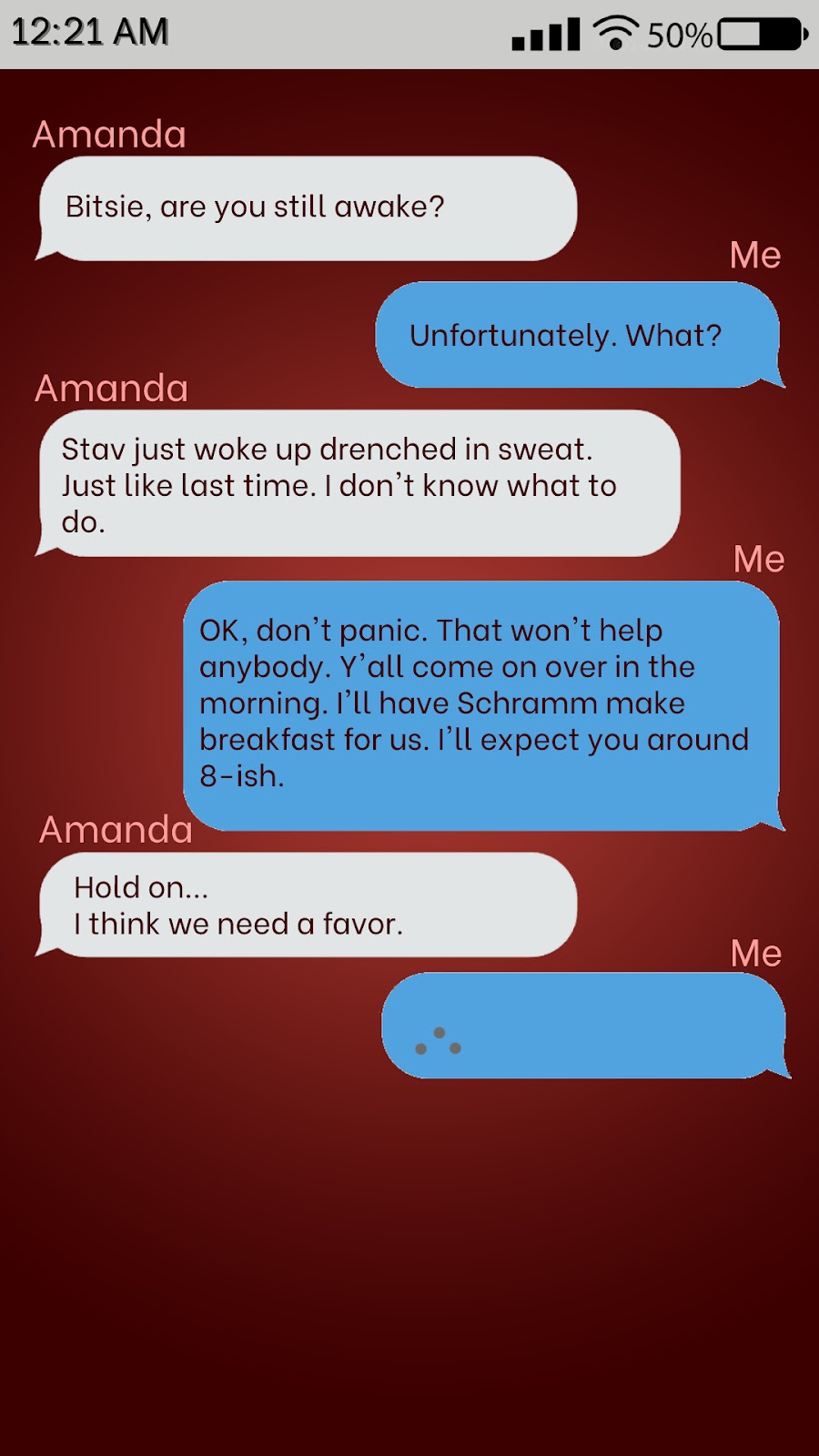
 : Sitting upright from a sound sleep in their bed, Stavros Phistemopheles gasps for air. He is drenched in sweat, soaking the sheets. Next to him, his fiancee Amanda Napolitano is shaken awake, and sits up, pushing her shoulder length chocolate brown hair out of her eyes.

“Babe, what’s the matter?” she asks.

“Το ένιωσα ξανά! Αυτή η αίσθηση τρόμου!”, he gasps, pushing his fingers through his wet blue-black mane, pulling it back from his face. He’s panting as if he’s just run a marathon. His olive skin is ashen and clammy. Amanda, pale as porcelain, pushes back the dampened sheets and circles the bed to grab a bottle of water on his nightstand.

“Sweetheart, all I can say in Greek at this hour is ‘I need a toilet’ and ‘where is duty-free?’” Grabbing a scrunchie from her night table, she pulls her hair back into a pony tail. She opens the bottle and hands it to him, which he takes and knocks back. As she goes to grab a towel from the bathroom, she calls back “Translate please.”

Stavros, at any other time an imposing physical presence, sits with his broad shoulders hunched over his knees, like a great weight pushing him down. All he can do is pant for breath, trying desperately to slow his pounding heart. Amanda returns and begins drying his shoulders and back. She’s only seen him like this once before. And that was a nightmare she doesn't want to revisit.

Trying to sound calm and soothing, she breathes in and says evenly “tell me what happened?”

Stavros swallows hard and is just about to speak when his cell phone rings loudly. All expression leaves his chiseled face, his eyes staring blankly across the bed. His heart rate slows almost instantly. His panting replaced by short, shallow breaths.

“Oh, fer Chrissakes!” Amanda grumbles, tossing the towel across Stavros’ still shoulders, running back around the bed to her nightstand. “It’s after midnight, who the hell is calling us? Rony, if that’s you, I'm gonna--”

The words freeze on her lips as she sees the caller ID. A sudden tremble wiggles up her spine. She picks up both phones from the charging pad. Silently, she walks back around, handing the ringing phone to Stavros, who takes it without looking. She disappears into the kitchen to make some coffee and text messages. He taps the screen blindly. As he raises the phone, the sound of a familiar ocean half a world away fills his ear. He closes his eyes and says defeatedly,

“Hello Aunt Phil”...This is My New Orleans.


Tuesday, July 23, 2024

The Mission of Oskar Hammar - Ch. 1, Part One

 : The pink, perpetually moist, round face of Oskar Hammar emerges from the Metairie Road bus into a sickly cloud of opal-amber diesel exhaust radiating in the setting sun. He steps down, narrowly avoiding a puddle only to land squarely on a string of beads left over from the recent parade. He stumbles, then kicks the strand into the gutter as the bus pulls away, another malevolent breath of smog engulfing him.

It doesn’t matter, he thinks to himself.

He makes his way down the sidewalk on Fagot, down Ridgelake and over to the remote one-block street called Shirmaine, down to the small post World War II starter home he grew up in. When he was a child, there were lots of houses like his in the neighborhood. Now, his and the other houses on the street are the only ones left, replaced over the years by pre-fab mini-mansions, each one taller and bigger than the last. 

Maybe that will change, he thinks to himself.

Even in the dark, the Hammar home stands out as the only one that looks deserted all the time. Arriving at home at last, he pads along the driveway to the carport, entering through the kitchen door. Inside is a time capsule of the late 20th century, all kept fastidiously clean and carefully used. It is the legacy of his parents. Well, his mother mostly. His father has been dead for 15 years. He was emotionally distant, violent, and poorly educated. Oskar barely remembers speaking at his funeral. But, he bought a solid house and paid for it all before he died. It was his mother he adored. She died early in the pandemic.

She was infected on Canal Street, watching the Rex Parade. Ash Wednesday night he rushed her in a cab to the hospital. The last he saw of her was being wheeled away on a gurney by masked nurses with their machines stabbed inside her. Ten days later she was lying in Tharp Sontheimer, one of the first to die after the shutdown began. No funeral. A solitary burial in Lakelawn, by her only surviving child, and a couple of masked strangers waiting for him to leave.

Oskar had always hated Carnival and Mardi Gras. Loathed it, actually. The only reason he went was because his mother adored it. The noise, the smells, the throws, the food, the crowds, everything he despised gave her delight. That was enough for him to endure it all. And then, it killed her.

Pushing the sweaty strands of pale blond hair away from his face, Oskar opens the door under the carport; the key slipping in like a familiar lover. Both lock and key are original equipment, wearing each other down over decades. Impossible to pick, his mother used to joke. Removing his shoes, he puts them into the little wooden box by the door and steps inside the darkened kitchen. 

Routine. Close door, lock door, put key on hook, flip on light. Drilled into him at five by his father, yelling in his face. Do it in order. Don’t miss a step. Make it routine. Flip on light!

A single circular fluorescent light buzzes to life over the ancient Formica dinette set against the wall decorated with a painted window and a wooden window box filled with plastic plants. The yellow walls, once the color of sunshine, have gone a pallid ochre. The small kitchen is avocado, but one well past its prime. The most recent appliance is the spotless radar range over the gas stove. His father installed it in 1975 for his mother because it was the latest thing. Everything gleams, with only a few chips of paint missing here and there. Despite being spotlessly clean, the room looks like how liver frying in onions smells. The brown patterned linoleum is in remarkable shape, due mostly to his late mother’s devotion to floor waxing.

She believed those commercials. The ones that promised health, happiness and domestic bliss were the direct result of a sparkling kitchen floor. He keeps it up for her, all of it regularly gleaming. Though, there is seldom any light to see it.

He takes off his jacket, hangs it on the hook near the door, and walks over to the sink. He pushes a button on the wall under the cabinets and another circular light above bathes him and the stainless steel sink in a ghastly blue-white light. 

Oskar washes his hands for one minute. He has always done this, ever since he was a pudgy, sullen child. Digging under his nails, he looks at the scrubber his mother kept on the sink. A little yellowed poof of plastic netting attached to a purple plastic knob with the initials K & B printed on the top. It upset her when that drugstore closed down. It was the only memory of the place she had left. It has never been used. She wouldn’t allow it.

The whole house is a time capsule of his family, left nearly as it was when they all died. But, not for sentimental reasons. He keeps everything exactly as he remembers. That way he knows if anything changes. He dries his hands on the dishtowel, hangs it up neatly folded on the rack, and turns out the light.

Walking through the dark, stagnant living room, past the boxy furniture, he walks down the darkened hallway covered in honey colored wood paneling. Parents bedroom, sister’s bedroom, Oskar’s bedroom. Well, Oskar’s old bedroom. After his mother died, he put her things in storage, and his late sister Alecia’s things out on the curb and moved into the main bedroom. His petty revenge on Alecia for being born.

He opens the door, which swings away into the darkness. He steps inside and is bathed in light.

The room is bare. That peculiar echo of empty rooms is disturbingly absent. Only the hum. The window on the opposite side has no curtains, looking out onto the dark, bleak rear yard and tall wooden fence.

In the center of the room is a simple wooden chair at a small card table. On top of the table is a silver metallic orb, the size of a basketball. The room is perfectly lit, despite there being no light source in the room. And that light stops at the doorway and the window. From the outside, the room is still dark

Oskar found the thing years ago, drawn to the low-level hum it produces. Touching the orb sent him back into the past. At first, it was only the past of his immediate family. It required a lot of concentration and always left him exhausted later. When Alecia died in the aftermath of Hurricane Katrina. Oskar went back and saved her, changing the world around him for the worse. His interference caused the deaths of both his father and sister. After that, his trips were strictly observational.

Until his mother died. The only one in the whole family he actually loved. The only one who mattered.

Oskar is going back again. This time, to save his mother. He has learned in his travels through time that merely plucking someone from their fate doesn’t work. You have to go back further. You have to fundamentally change the circumstances that brought about the conditions of the thing you want changed.

Oskar is going back further than he’s ever gone before. To the mid- 19th century. He has his agenda in place, he’s nearly completed the research. He knows the names, the places, the events he needs to change. He just needs a few more items before he begins the end.

He’s going back in time to kill Mardi Gras…This is My New Orleans.